
Location, Location, Location: How College Strategy Influences Where the Ultra-Wealthy Live
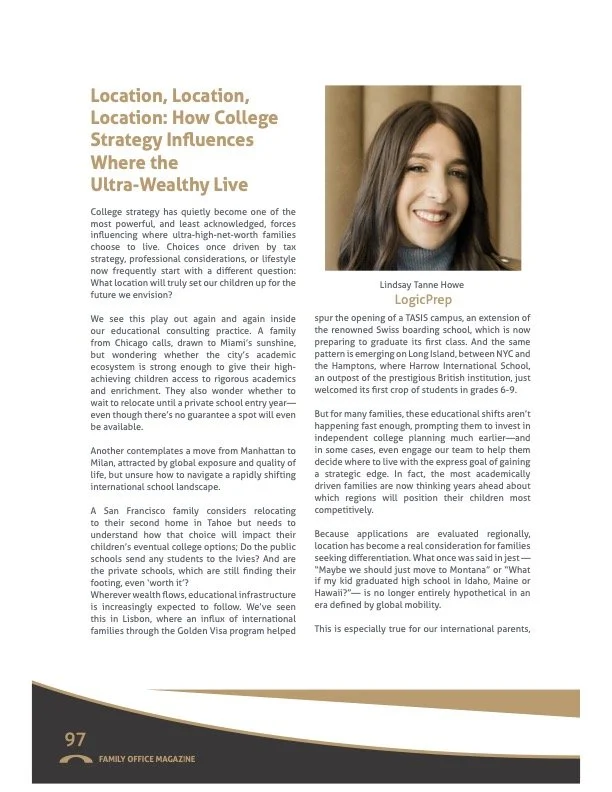
By Lindsay Tanne Howe
College strategy has quietly become one of the most powerful, and least acknowledged, forces influencing where ultra-high-net-worth families choose to live. Choices once driven by tax strategy, professional considerations, or lifestyle now frequently start with a different question: What location will truly set our children up for the future we envision?
We see this play out again and again inside our educational consulting practice. A family from Chicago calls, drawn to Miami’s sunshine, but wondering whether the city’s academic ecosystem is strong enough to give their high-achieving children access to rigorous academics and enrichment. They also wonder whether to wait to relocate until a private school entry year—even though there’s no guarantee a spot will even be available.
Another contemplates a move from Manhattan to Milan, attracted by global exposure and quality of life, but unsure how to navigate a rapidly shifting international school landscape.
A San Francisco family considers relocating to their second home in Tahoe but needs to understand how that choice will impact their children’s eventual college options; Do the public schools send any students to the Ivies? And are the private schools, which are still finding their footing, even ‘worth it’?
Wherever wealth flows, educational infrastructure is increasingly expected to follow. We’ve seen this in Lisbon, where an influx of international families through the Golden Visa program helped spur the opening of a TASIS campus, an extension of the renowned Swiss boarding school, which is now preparing to graduate its first class. And the same pattern is emerging on Long Island, between NYC and the Hamptons, where Harrow International School, an outpost of the prestigious British institution, just welcomed its first crop of students in grades 6-9.
But for many families, these educational shifts aren’t happening fast enough, prompting them to invest in independent college planning much earlier—and in some cases, even engage our team to help them decide where to live with the express goal of gaining a strategic edge. In fact, the most academically driven families are now thinking years ahead about which regions will position their children most competitively.
Because applications are evaluated regionally, location has become a real consideration for families seeking differentiation. What once was said in jest — “Maybe we should just move to Montana” or “What if my kid graduated high school in Idaho, Maine or Hawaii?”— is no longer entirely hypothetical in an era defined by global mobility.
This is especially true for our international parents, who routinely ask the hardest questions: Are the local high schools strong enough for competitive U.S. college admissions? Would boarding school abroad offer an advantage, or could applying from the U.S. actually hurt my child’s chances?
These decisions often surface deeper questions about values. Families begin weighing not just academic pathways, but which environments best align with their culture, support their child’s wellbeing, and shape the kind of young adult they hope to raise.
One American family, for example, recently chose to relocate from Utah to Barcelona so their children could experience a new culture. This was an adventure they felt was better experienced together than by sending them to a boarding school like Le Rosey or Aiglon. In this way, education planning is as much about selecting a school as it is about choosing a path that aligns with a family’s values and priorities.
Increasingly, the choice of where to live has become a core driver of opportunity, mobility, and the legacy UHNW families want to secure for their children. Looking ahead, we anticipate families will continue to be more geographically mobile, with communities evolving to meet their educational interests through new schools and programs. The influence is bidirectional, however: families are making relocation decisions based on long-term educational strategy, while communities are actively upgrading their educational offerings to attract and retain those families.
With so much in flux, one thing is clear: families benefit most from approaching education planning as part of a broader wealth and life-planning framework. A holistic perspective supports more intentional decision making about where to live, how to allocate resources, and which environments will best shape next generation’s development, access, and opportunity over time. After all, for UHNW families, real estate is education strategy.
Lindsay Tanne Howe launched LogicPrep while a student at Harvard. Nearly two decades later, the firm is a global college admissions consultancy, providing comprehensive college guidance, strategic test preparation, and academic support.
This article was originally published in Family Office Magazine in the Spring 2026 issue and can be viewed here.